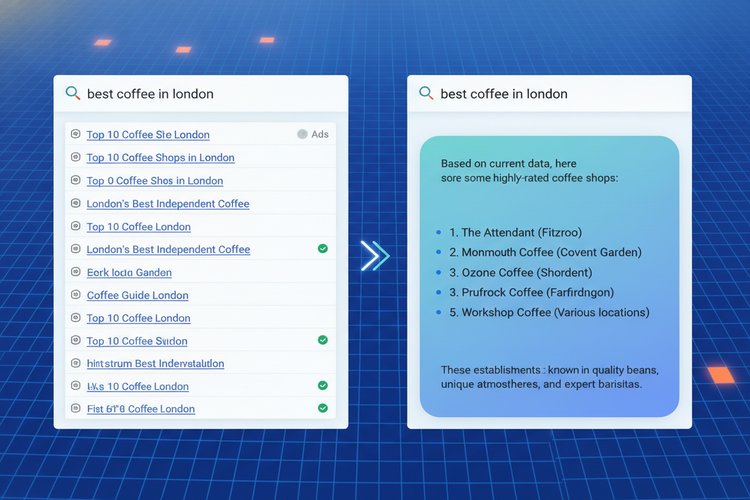
Search behavior is undergoing a massive shift. For over two decades, search engine optimization (SEO) focused on driving website traffic by ranking blue links on Google. Today, AI search tools like ChatGPT, Perplexity, and Google AI Overviews are changing how users find information.
Instead of scrolling through pages of search results, users now expect instant, direct answers to their questions. This shift created Answer Engine Optimization (AEO), a strategy designed to help your brand become the cited source for AI-generated answers.
SEO gets your website ranked in search results, but AEO gets your content cited inside AI-generated answers.
What Is SEO (Search Engine Optimization)?
Search Engine Optimization (SEO) is the process of optimizing web pages to rank higher on search engine results pages (SERPs). The main goal of traditional SEO is to attract organic traffic by matching user queries with relevant website content.
Traditional SEO relies on three core pillars:
- On-Page SEO: Optimizing titles, headings, body text, and internal links to match targeted keywords.
- Technical SEO: Ensuring search engine crawlers can index your pages using clean site architecture, fast loading speeds, and tools like a robots.txt generator.
- Off-Page SEO: Building domain authority through high-quality backlinks from reputable external sites.
When you run a query on a traditional search engine, the system returns a list of indexed links. You then click through to a website to read the information yourself. If your site needs a traffic boost, applying a technical blog content refresh strategy can help reclaim lost search rankings.
What Is AEO (Answer Engine Optimization)?
Answer Engine Optimization (AEO) is the practice of structuring and writing content so artificial intelligence models can easily extract, summarize, and cite it as a direct answer. Rather than sending a user to a list of external links, answer engines synthesize information into a single response.
AEO targets conversational search tools and AI platforms, including:
- Google AI Overviews and Featured Snippets
- ChatGPT Search and OpenAI SearchGPT
- Perplexity AI
- Claude and Gemini assistant models
- Voice assistants like Apple Siri and Amazon Alexa
When someone asks an AI tool a specific question, the engine scans trusted documents across the web. It extracts factual fragments and credits the source with an inline citation link. AEO ensures your website is the primary reference source for those AI responses.
While SEO optimizes for human clicks from search results, AEO optimizes for AI models that read and summarize data.
SEO vs AEO: Key Differences Compared
Understanding the difference between SEO and AEO requires looking at how users search, how content is processed, and how success is measured.
Search Intent and Query Types
SEO primarily targets keyword phrases with distinct search intents, such as informational, commercial, or transactional queries (for example, “best web hosting” or “buy running shoes”). Users expect to browse multiple options on a results page.
AEO focuses on direct, conversational questions and complex multi-part prompts. Users want immediate answers without visiting multiple websites (for example, “What is the difference between shared hosting and VPS hosting for a small blog?”).
Content Structure and Format
SEO content often uses long-form articles designed to cover a broad topic thoroughly, encouraging users to stay on the page and explore. Writers rely on storytelling, visual layouts, and strategic keyword placement.
AEO content demands clear, concise, and modular formatting. AI engines look for direct definitions, bulleted lists, structured tables, and clear subject-predicate relationships that can be easily parsed and extracted.
Success Metrics and KPI Tracking
SEO success is measured through traditional web metrics: organic impressions, click-through rates (CTR), organic traffic, and time spent on page. You can evaluate tools using an SEOWriting.ai review to speed up production while keeping track of performance.
AEO performance relies on brand visibility metrics, such as citation rate, AI answer inclusion, brand mentions in generative summaries, and direct referral traffic from AI sources.
Here is a side-by-side comparison matrix highlighting the core differences between SEO vs AEO:
| Feature | SEO (Search Engine Optimization) | AEO (Answer Engine Optimization) |
|---|---|---|
| Primary Goal | Rank web pages in search engine results | Provide direct answers cited by AI engines |
| Target Audience | Human searchers scanning link lists | AI models, LLMs, and voice assistants |
| Query Format | Short-tail and long-tail keywords | Natural language questions and prompts |
| Content Style | Comprehensive long-form pages | Concise definitions, Q&A blocks, and tables |
| Technical Focus | Site speed, crawl budget, and indexability | Structured data, schema markup, and clear entities |
| Success Metric | Organic clicks, traffic, and rankings | AI citations, brand mentions, and referrals |
How AI Engines Search and Extract Direct Answers
AI search engines do not read websites the way humans do. Instead of browsing a full page, large language models (LLMs) use Retrieval-Augmented Generation (RAG) to find relevant facts from an indexed index or live web search.
When an answer engine receives a user prompt, it follows three main steps:
- Parsing the Question: The model breaks down the query into core concepts and intent tags.
- Document Retrieval: It searches live web results or cached databases for authoritative pages covering those specific concepts.
- Synthesis and Citation: The LLM selects the most clear, factual sentences, synthesizes a concise response, and embeds source links back to the original documents.
To help answer engines parse your site correctly, implementing structured data from Schema.org is essential. Schema markup gives AI models explicit clues about the meaning of a page, its authors, and its core entities.
If an AI model cannot verify the facts on your page within milliseconds, it will skip your content and cite a competitor.
How to Optimize Your Content for AEO
Adapting your website strategy for answer engine optimization does not mean throwing away your traditional SEO efforts. Instead, you layer AEO practices on top of your existing search foundation.
Use Clear Question-and-Answer Headers
Structure your content around explicit questions that your target audience asks. Use H2 or H3 headings that state the question directly, followed immediately by a clear, one-to-two sentence direct answer before expanding into detail.
Implement Schema Markup and Structured Data
Add FAQ, Article, Product, and HowTo schema markup to your pages. Structured markup acts as a universal translator for AI web crawlers, ensuring your key facts are indexed accurately.
Focus on Entity-Based Content and Concise Lists
Explain key technical concepts using unambiguous language. Use bulleted lists, numbered steps, and clean data tables. AI models prefer structured text over long walls of narrative prose.
Maintain Technical Accessibility and Machine-Readable Content
Ensure your site is easily crawlable by automated scrapers and AI agents. Provide explicit directives in your site configuration files so bots can discover your high-value assets without hitting blockages.
Will Answer Engine Optimization Replace SEO?
Answer Engine Optimization will not replace traditional SEO; rather, AEO is the next evolutionary layer of search optimization. Traditional search engines and AI search engines rely on the same underlying foundation: high-quality, authoritative, and fast-loading web pages.
Without solid foundational SEO—such as clean crawlability, strong site structure, and domain authority—AI answer engines cannot find or trust your website in the first place. Therefore, a successful digital strategy integrates both approaches to capture traditional search traffic and generative AI citations.
Key Takeaways
- SEO targets page rankings, while AEO targets direct citations within AI-generated responses.
- AEO requires modular formatting, including direct Q&A headers, concise definitions, and clear data tables.
- Structured data and Schema.org markup are critical for helping LLMs parse and verify your content.
- Traditional SEO remains the foundation for site discovery and domain authority, making SEO and AEO complementary strategies.